Genuine Curt Teich
Vintage YMCA Hotel Chicago Linen Postcard Roof Garden Curt Teich 1940s
Flat $2.00 USPS First Class shipping on all postcards within the continental USA.
Low stock: 1 left
Couldn't load pickup availability
AT A GLANCE
- Title:
- “Roof Garden YMCA Hotel Chicago, Illinois”
- Publisher:
- Genuine Curt Teich Chicago, Illinois
- Type:
- Standard Size Postcard (3 ½” x 5 ½”)
- Subject:
- Hotel, rooftop garden terrace
- Style:
- Travel; hospitality advertising
- Era:
- Interwar Period (1918 – 1941)
- Circa:
- Early 1940s
- Print type:
- Lithographic print (linen finish)
- Condition:
- Good (G)
- Color:
- Color (highly saturated)
- Postcard:
- Linen
- Location:
- Chicago, Illinois USA
- Postmark:
- Unposted | Unused
- Notes:
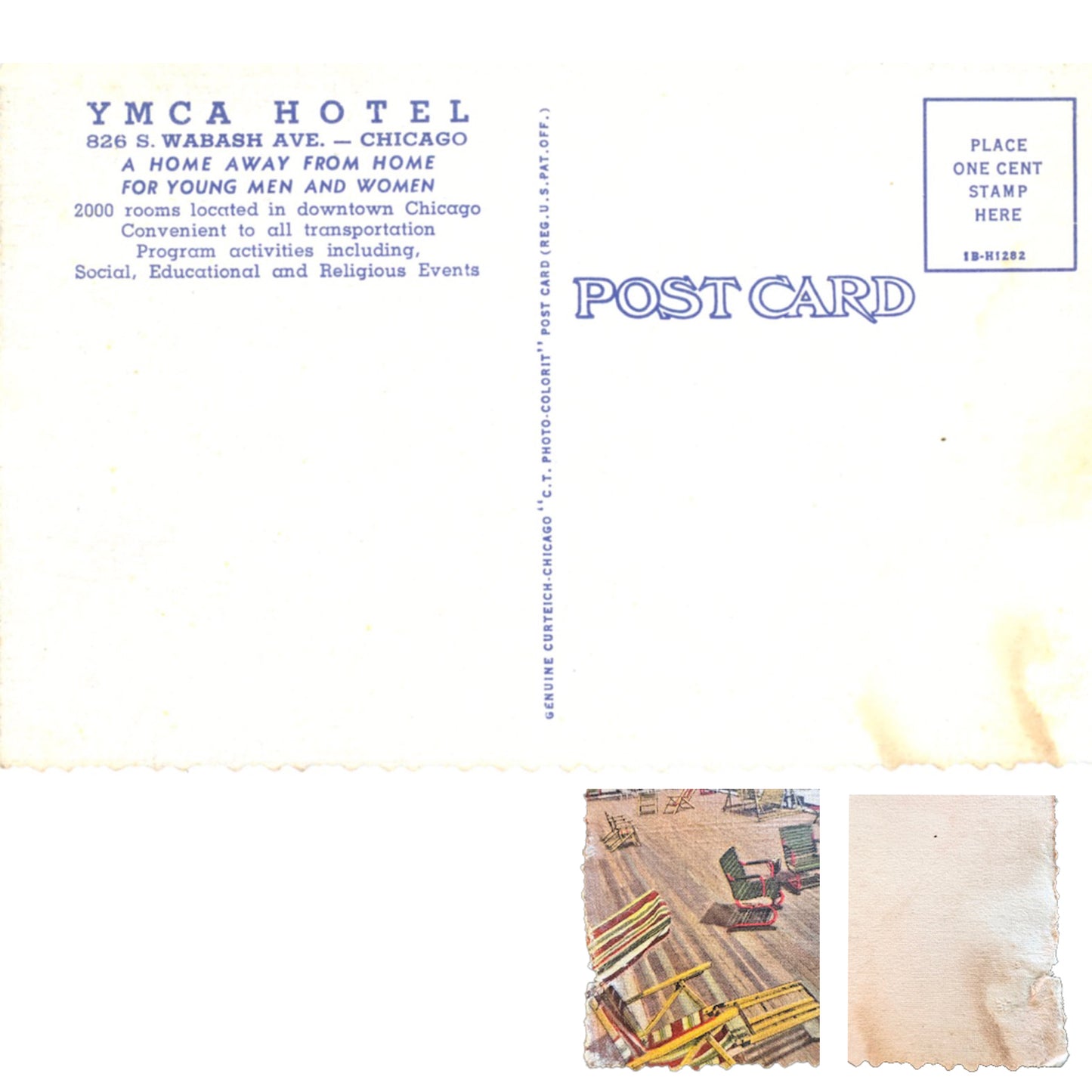
- Curt Teich “C.T. Photo-Colorit” postcard | Deckled edge | Water damage lower right corner
Colorful linen era postcard featuring the rooftop garden terrace of Chicago’s famed YMCA Hotel.
Collector’s Note
The YMCA Hotel at 826 South Wabash Avenue was one of Chicago’s best-known affordable downtown accommodations during the interwar and postwar years, welcoming travelers, students, servicemen, and young professionals from across the country.
Vintage linen era souvenir postcard depicting the “Roof Garden — YMCA Hotel, Chicago, Illinois,” published by Genuine Curt Teich of Chicago and marked “C.T. Photo-Colorit.” The postcard showcases the hotel’s rooftop recreation terrace overlooking Lake Michigan, complete with brightly colored deck chairs, umbrella tables, shuffleboard courts, and social gathering spaces typical of large urban hotels during the late 1930s and early 1940s.
The reverse advertises the YMCA Hotel as “A Home Away From Home For Young Men and Women,” noting its 2,000 downtown guest rooms, convenient transportation access, and organized social, educational, and religious activities. Curt Teich’s richly saturated linen postcards became iconic American travel souvenirs during this period and are highly collected today for their vibrant color and documentary view of everyday mid-century life.
Unposted postcard with deckled edge. Condition is good with visible water damage and staining concentrated primarily to the lower right corner on the reverse, with minor corresponding wear visible from the front. Still displays well overall and has been priced accordingly for condition. Packaged in a protective postcard sleeve.
Framing Appeal
The vivid rooftop scene, colorful deck furnishings, and sweeping Lake Michigan backdrop make this postcard an appealing display piece for collectors of Chicago travel memorabilia and vintage hospitality ephemera.
Just a quick heads‑up: the photos reveal details far better than text alone, so they’re worth a close review.
We share as much accurate information as possible about each item—from provenance to condition—but the images often show the nuances best. If you ever need more details, we’re always happy to help.
Share this listing.

Postcard Eras & Collecting Guide
-
Real Photo Postcards (c. 1890–1945)
Browse Real PostcardsEarly printed lithographs and Real Photo Postcards (RPPC) offer rich historical detail, documenting towns, events, family portraits, and everyday life. Disaster postcards depicting floods, fires, train wrecks, and other catastrophic events, were a popular way to share news as photographs could quickly be turned into postcards. Many RPPCs are scarce and unique due to their small‑batch production.
-
Pre-Linen Litho & Linen Postcards (c. 1907–1950)
Browse Pre-Linen Litho and Linen PostcardsPre‑Linen Litho cards (c. 1907–1929) were printed using smooth chromolithography and tinted halftone methods, producing soft, painterly views before the textured linen era. Linen postcards (c. 1930s–1950s) introduced high–rag‑content paper with a woven surface and bold saturated colors that reflected the optimism postwar travel culture. Together, these eras showcase the shift from early color printing.
-
Chrome Postcards (c.1939–)
Browse Chrome PostcardsChrome postcards, introduced in 1939, feature glossy surfaces, vivid color, and photographic imagery made possible by modern color film processes. The term “chrome” derives from Kodachrome, Eastman Kodak’s groundbreaking color film. Mid‑century examples depicting motels, highways, city skylines, national parks, and tourist destinations are collected for their documentation of postwar American travel and roadside culture.