Skip to product information
1 of 2

Applied Arts Publishing | Melvin Horst

Paradise Covered Bridge and Amish Carriage - Lancaster County PA | Melvin Horst Chrome Era Postcard

Paradise Covered Bridge and Amish Carriage - Lancaster County PA | Melvin Horst Chrome Era Postcard

Regular price $6.50 USD
Regular price Sale price $6.50 USD
Sale Sold out
Shipping calculated at checkout.

Flat $2.00 USPS First Class shipping on all postcards within the continental USA.


Low stock: 1 left

Quantity

AT A GLANCE

Title:
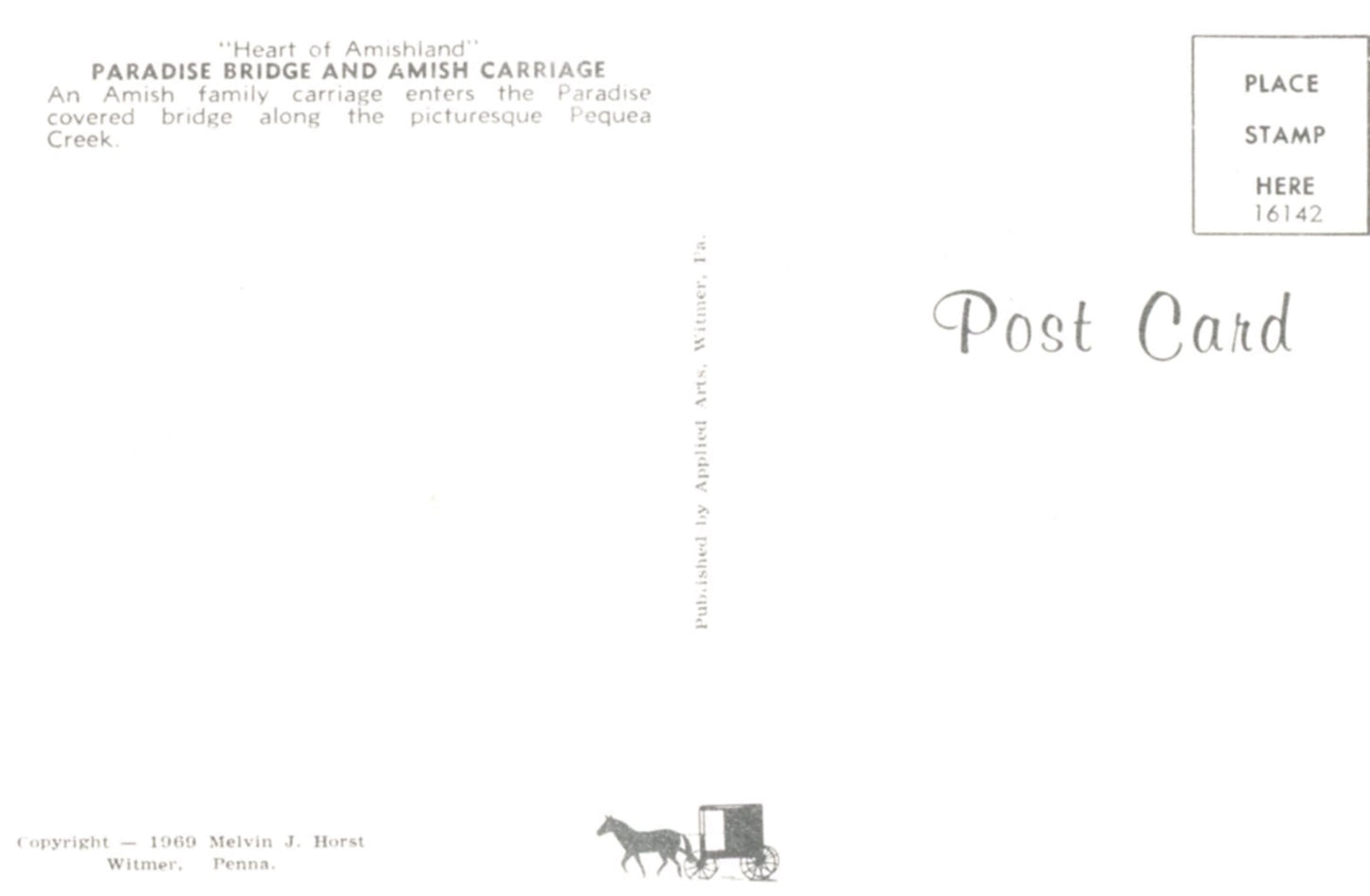
“Heart of Amishland – Paradise Bridge and Amish Carriage”
Publisher:
Applied Arts Publishing, Witmer PA
Type:
Standard Size Postcard (3 ½” x 5 ½”)
Subject:
Horse-drawn Amish buggy, covered bridge
Style:
Documentary, rural photography
Circa:
1969
Print type:
Photochrome print
Condition:
Excellent (EX)
Color:
Glossy
Postcard:
Chrome
Photographer:
Melvin J. Horst (1929 - 2008)
Location:
Lancaster County, Pennsylvania USA
Postmark:
Unposted | Unused
Notes:
Code #16142

Vintage 1969 postcard titled “Heart of Amishland – Paradise Bridge and Amish Carriage,” featuring an Amish family carriage entering the historic Paradise covered bridge along the picturesque Pequea Creek in Lancaster County, Pennsylvania. The scene captures the quiet rural charm of Amish Country: a red‑sided covered bridge, stone abutments, lush greenery, and a traditional horse‑drawn buggy crossing the span.

Copyrighted in 1969 by Melvin J. Horst and published by Applied Arts Publishers of Witmer, Pennsylvania, this postcard reflects the region’s long‑standing postcard tradition documenting Amish life, covered bridges, and Lancaster County landscapes. Arrives in a protective sleeve — ideal for collectors of Amish culture, Pennsylvania covered bridges, and mid‑century regional postcards.

Just a quick heads‑up: the photos reveal details far better than text alone, so they’re worth a close review.

We share as much accurate information as possible about each item—from provenance to condition—but the images often show the nuances best. If you ever need more details, we’re always happy to help.

View full details
  • Real Photo Postcards (c. 1890–1945)

    Early printed lithographs and Real Photo Postcards (RPPC) offer rich historical detail, documenting towns, events, family portraits, and everyday life. Disaster postcards depicting floods, fires, train wrecks, and other catastrophic events, were a popular way to share news as photographs could quickly be turned into postcards. Many RPPCs are scarce and unique due to their small‑batch production.

    Browse Real Postcards 
  • Pre-Linen Litho & Linen Postcards (c. 1907–1950)

    Pre‑Linen Litho cards (c. 1907–1929) were printed using smooth chromolithography and tinted halftone methods, producing soft, painterly views before the textured linen era. Linen postcards (c. 1930s–1950s) introduced high–rag‑content paper with a woven surface and bold saturated colors that reflected the optimism postwar travel culture. Together, these eras showcase the shift from early color printing.

    Browse Pre-Linen Litho and Linen Postcards 
  • Chrome Postcards (c.1939–)

    Chrome postcards, introduced in 1939, feature glossy surfaces, vivid color, and photographic imagery made possible by modern color film processes. The term “chrome” derives from Kodachrome, Eastman Kodak’s groundbreaking color film. Mid‑century examples depicting motels, highways, city skylines, national parks, and tourist destinations are collected for their documentation of postwar American travel and roadside culture.

    Browse Chrome Postcards