Walter H. Miller | Old Sturbridge Village
Old Sturbridge Village - Gen. Salem Towne House & Richardson House | Chrome Era Postcards (Sold Choice)
Flat $2.00 USPS First Class shipping on all postcards within the continental USA.
Low stock: 1 left
Couldn't load pickup availability
AT A GLANCE
- Publisher:
- Old Sturbridge Village
- Type:
- Standard Size Postcard (3 ½” x 5 ½”)
- Subject:
- Parlor, bedroom, period antiques
- Style:
- Documentary, museum collections
- Circa:
- Produced late 1960s to 1970s
- Print type:
- Photochrome print
- Condition:
- Excellent (EX)
- Color:
- Glossy
- Postcard:
- Chrome
- Photographer:
- Walter H. Miller
- Location:
- Sturbridge, Massachusetts USA
Vintage interior postcards from Old Sturbridge Village in Massachusetts, each featuring historically accurate 18th‑century domestic rooms photographed by Walter H. Miller. These richly detailed views highlight the museum’s period‑correct furnishings, architectural woodwork, and decorative arts, offering a glimpse into early New England life.
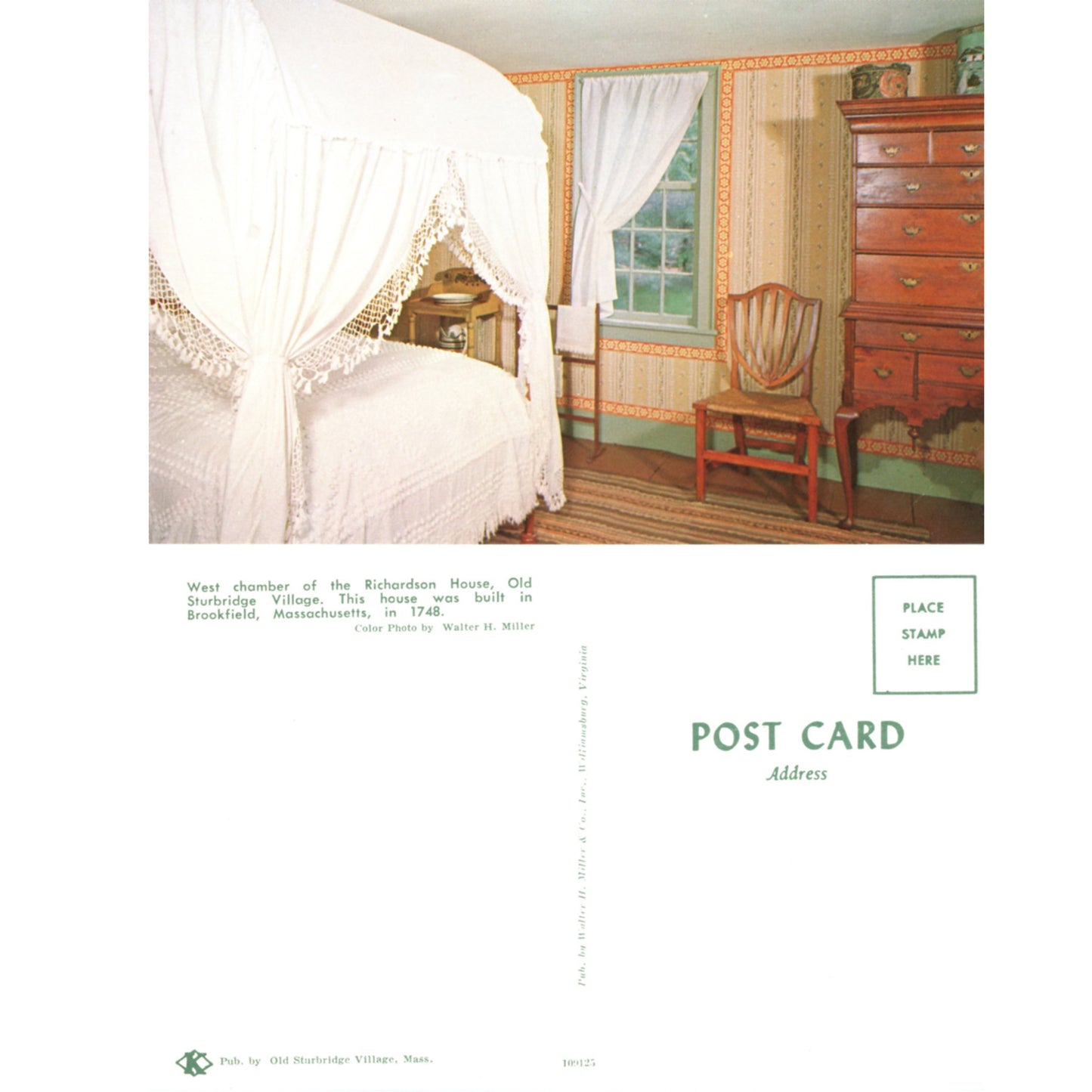
The first card shows the parlor of the Gen. Salem Towne House (built 1796), complete with fireplace, tea table, patterned wallpaper, and formal seating. The second depicts the west chamber of the Richardson House (built 1748), featuring a canopy bed, highboy chest, woven rug, and traditional colonial décor.
Both postcards are well‑preserved and arrive in protective sleeves. Ideal for collectors of New England history, museum ephemera, early American interiors, and Old Sturbridge Village memorabilia. Sold individually.
Choose your postcard using the selector button — each option displays the exact card you will receive.
Salem Towne House
- Parlor; period antiques
- Postmark: August 7, 1975 - Quaker Street, New York
- Message: Handwritten
- Postage Stamp: 10c Jefferson Memorial, affixed and canceled
- Code #124075
Richardson House
Vintage chrome era souvenir postcard featuring the parlor of the General Salem Towne House located in Old Sturbridge Village. The house was built in Charlton, Massachusetts in 1796.
- West bed chamber; canopy bed and antique highboy
- Unposted
- Code #109125
Just a quick heads‑up: the photos reveal details far better than text alone, so they’re worth a close review.
We share as much accurate information as possible about each item—from provenance to condition—but the images often show the nuances best. If you ever need more details, we’re always happy to help.
Share this listing.

Postcard Eras & Collecting Guide
-
Real Photo Postcards (c. 1890–1945)
Browse Real PostcardsEarly printed lithographs and Real Photo Postcards (RPPC) offer rich historical detail, documenting towns, events, family portraits, and everyday life. Disaster postcards depicting floods, fires, train wrecks, and other catastrophic events, were a popular way to share news as photographs could quickly be turned into postcards. Many RPPCs are scarce and unique due to their small‑batch production.
-
Pre-Linen Litho & Linen Postcards (c. 1907–1950)
Browse Pre-Linen Litho and Linen PostcardsPre‑Linen Litho cards (c. 1907–1929) were printed using smooth chromolithography and tinted halftone methods, producing soft, painterly views before the textured linen era. Linen postcards (c. 1930s–1950s) introduced high–rag‑content paper with a woven surface and bold saturated colors that reflected the optimism postwar travel culture. Together, these eras showcase the shift from early color printing.
-
Chrome Postcards (c.1939–)
Browse Chrome PostcardsChrome postcards, introduced in 1939, feature glossy surfaces, vivid color, and photographic imagery made possible by modern color film processes. The term “chrome” derives from Kodachrome, Eastman Kodak’s groundbreaking color film. Mid‑century examples depicting motels, highways, city skylines, national parks, and tourist destinations are collected for their documentation of postwar American travel and roadside culture.