Skip to product information
1 of 8

Twin City Printery

Montpelier Knox Mansion Thomaston Maine | Twin City Printery Vintage Interior and Exterior Postcards (Sold Choice)

Montpelier Knox Mansion Thomaston Maine | Twin City Printery Vintage Interior and Exterior Postcards (Sold Choice)

Select choice postcard from the options below:
Regular price $5.50 USD
Regular price Sale price $5.50 USD
Sale Sold out
Shipping calculated at checkout.

Flat $2.00 USPS First Class shipping on all postcards within the continental USA.


Low stock: 1 left

Quantity

AT A GLANCE

Title:
"Montpelier, the Knox Mansion"
Publisher:
Twin City Printery
Type:
Standard Size Postcard (3 ½” x 5 ½”)
Subject:
Historic house, Federal‑period interiors
Style:
Documentary, museum collections
Circa:
1950s to early 1960s
Print type:
Photochrome print
Condition:
Excellent (EX)
Color:
Glossy
Postcard:
Chrome
Photographer:
Arthur M. Griffiths
Location:
Thomaston, Maine
Postmark:
Unposted | Unused

Vintage mid-century postcards featuring Montpelier, the Knox Mansion in Thomaston, Maine — the reconstructed home of Revolutionary War General Henry Knox. Published by Arthur M. Griffiths of Monmouth, Maine, and printed by Twin City Printery in Lewiston, these cards document both the stately exterior and the richly furnished interior rooms that reflect the mansion’s Federal‑era elegance. Each postcard highlights a different space within the historic estate, from architectural grandeur to domestic detail.

All cards are unposted and in excellent condition, offered individually within this listing. A refined addition for collectors of Maine landmarks, historic house museums, Federal‑period architecture, and Montpelier/Knox memorabilia.

Exterior View of Mansion

  • Full exterior of Montpelier, the Knox Mansion
  • Neoclassical façade with columned entrance
  • American flag on front lawn

Oval Room

  • Famous oval room insisted upon by Henry Knox
  • Rare Kirmanshah rug; Waterford glass chandelier
  • Bible presented by Knox to the North Parish Meeting House

Dining Room

  • Original dining table, Louis XVI buffet and china
  • Wallpaper reproduced from original design
  • Fireplace with mirror and period furnishings

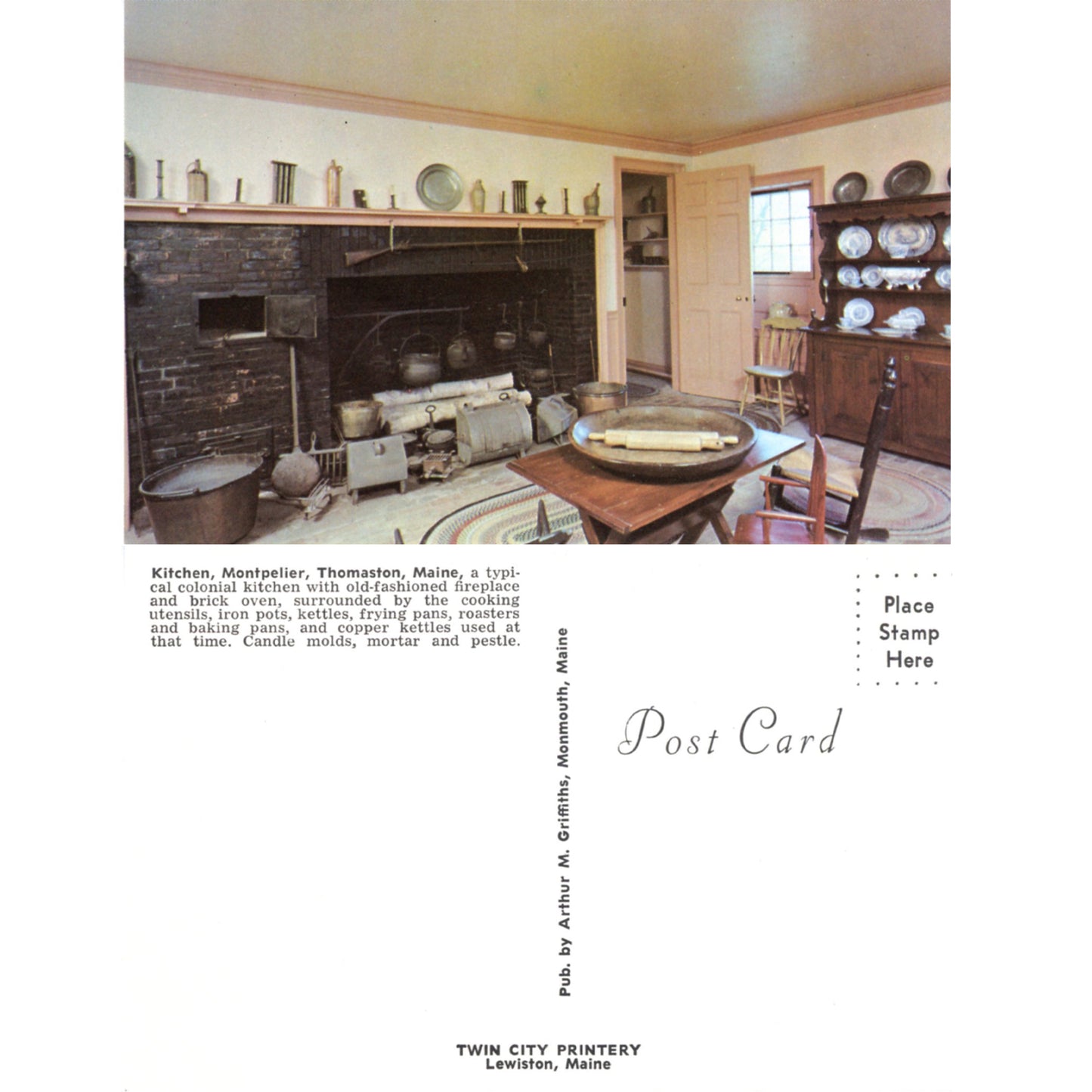
Colonial Kitchen

  • Brick fireplace and oven with iron pots, kettles, roasters, and copper cookware
  • Candle molds, mortar and pestle, and early domestic tools
  • Classic interpretation of an 18th century working kitchen

Just a quick heads‑up: the photos reveal details far better than text alone, so they’re worth a close review.

We share as much accurate information as possible about each item—from provenance to condition—but the images often show the nuances best. If you ever need more details, we’re always happy to help.

View full details
  • Real Photo Postcards (c. 1890–1945)

    Early printed lithographs and Real Photo Postcards (RPPC) offer rich historical detail, documenting towns, events, family portraits, and everyday life. Disaster postcards depicting floods, fires, train wrecks, and other catastrophic events, were a popular way to share news as photographs could quickly be turned into postcards. Many RPPCs are scarce and unique due to their small‑batch production.

    Browse Real Postcards 
  • Pre-Linen Litho & Linen Postcards (c. 1907–1950)

    Pre‑Linen Litho cards (c. 1907–1929) were printed using smooth chromolithography and tinted halftone methods, producing soft, painterly views before the textured linen era. Linen postcards (c. 1930s–1950s) introduced high–rag‑content paper with a woven surface and bold saturated colors that reflected the optimism postwar travel culture. Together, these eras showcase the shift from early color printing.

    Browse Pre-Linen Litho and Linen Postcards 
  • Chrome Postcards (c.1939–)

    Chrome postcards, introduced in 1939, feature glossy surfaces, vivid color, and photographic imagery made possible by modern color film processes. The term “chrome” derives from Kodachrome, Eastman Kodak’s groundbreaking color film. Mid‑century examples depicting motels, highways, city skylines, national parks, and tourist destinations are collected for their documentation of postwar American travel and roadside culture.

    Browse Chrome Postcards