Skip to product information
1 of 7

Arthur Guinness, Son & Co. | Hely's Limited

Guinness Brewery Dublin Postcard Series | St. James’s Gate (Sold Choice)

Guinness Brewery Dublin Postcard Series | St. James’s Gate (Sold Choice)

Regular price $16.00 USD
Regular price Sale price $16.00 USD
Sale Sold out
Shipping calculated at checkout.

Flat $2.00 USPS First Class shipping on all postcards.


Quantity
Select your choice Guinness postcard for the options below:

AT A GLANCE

Title:
"World's Largest Brewery"
Publisher:
Arthur Guinness, Son & Co. Ltd.
Type:
Continental Size Postcard (4" x 6")
Subject:
Brewery views; industrial process; Guinness
Style:
Industrial; Advertising Ephemera
Era:
Early 20th Century (1900 - 1945)
Circa:
1925 - 1940
Print type:
Halftone Lithographic
Condition:
Good (G)
Color:
Sepia-toned
Postcard:
Photographic-Style
Location:
Dublin, Ireland
Postmark:
Unposted | Unused
Notes:
Printer: Hely’s Limited, Dublin

Low stock: 1 left

A series of vintage Guinness brewery postcards featuring views of the famed St. James’s Gate Brewery in Dublin, Ireland—once promoted as the largest brewery in the world. Each card presents a different stage of the brewing process or an aerial view of the expansive industrial complex.

Published by Arthur Guinness, Son & Co., Ltd. and printed in Ireland by Hely’s Limited, Dublin, these postcards form part of a coordinated series (G.A. numbers) illustrating the scale and operations of early 20th-century brewing—from malting floors and mash tuns to cooperage yards and storage vats.

Produced in a photographic printing style typical of the period (c. 1925–1940), the cards have a warm sepia tone and documentary quality, appealing to collectors of industrial history, advertising ephemera, and Guinness memorabilia.

All postcards are sold individually. Condition is good overall, with light foxing, toning, and edge wear consistent with age. Ships in a protective sleeve.

Choose your postcard using the selector button — each option displays the exact card you will receive. 

Aerial View (G.A. 3)

  • Aerial views of the complex — malt stores, breweries, vat houses, racking sheds and cooperage yard.
  • Quays of the River Liffey in the background.

Malting Floor (G.A. 7)

  • Features barley spread on floor, steeped in water to encouraged germination.

Mash Tuns (G.A. 8)

  • View of vessels where constituents of malt soluble in water are extracted--creating the sweet liquor, called wort.

Coppers (G.A. 9)

  • View of coppers where the wort is boiled with hops after the mashing process.

Storage Vats (G.A. 11)

  • Features 179 storage vats used to store the beer before moved into casks for distribution. The largest vat holds 90,000 gallons. 

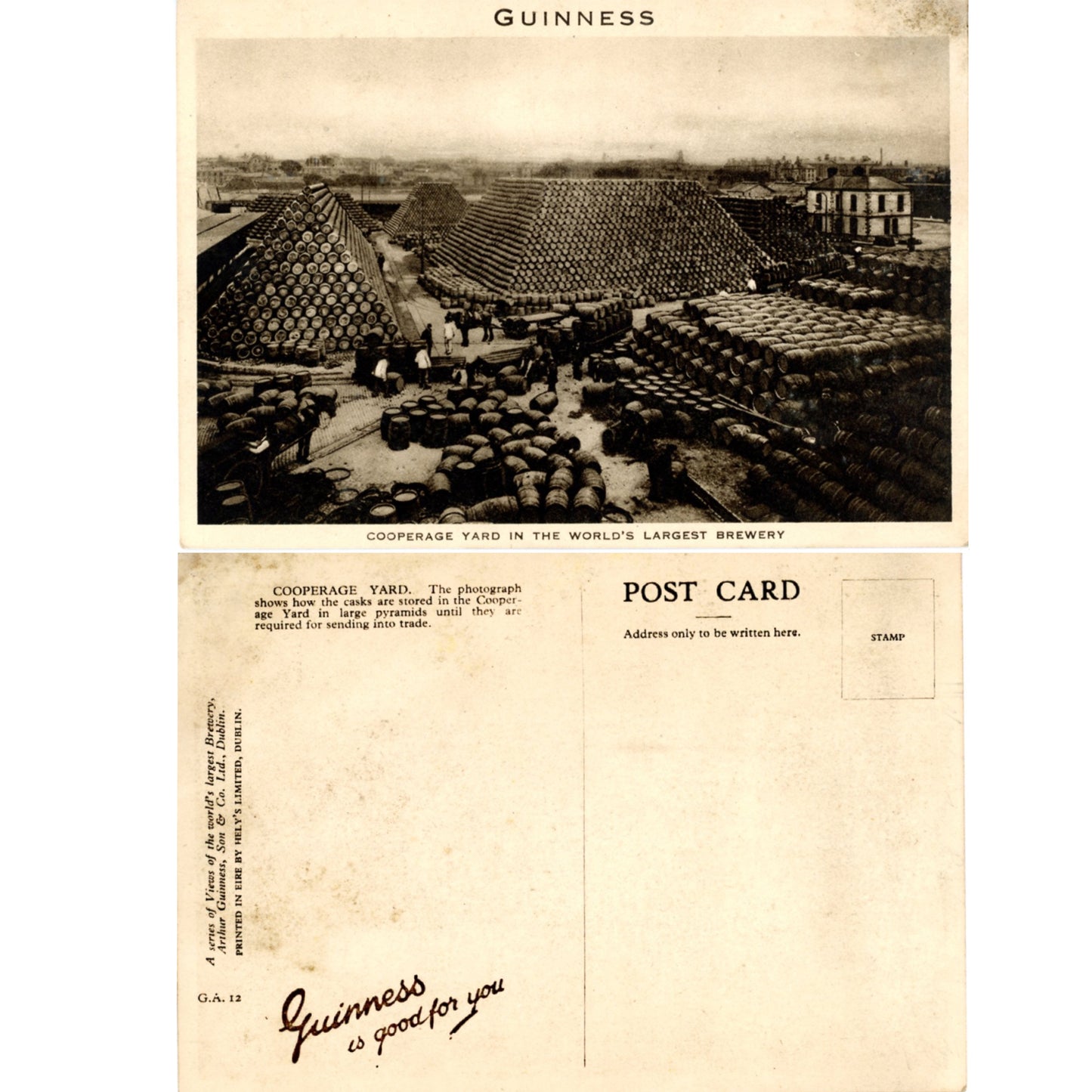
Cooperage Yard (G.A. 12)

    • Large pyramids of stored casks ready to send into trade. 
    View full details
    • Real Photo Postcards (c. 1890–1945)

      Early printed lithographs and Real Photo Postcards (RPPC) offer rich historical detail, documenting towns, events, family portraits, and everyday life. Disaster postcards depicting floods, fires, train wrecks, and other catastrophic events, were a popular way to share news as photographs could quickly be turned into postcards. Many RPPCs are scarce and unique due to their small‑batch production.

      Browse Real Postcards 
    • Pre-Linen Litho & Linen Postcards (c. 1907–1950)

      Pre‑Linen Litho cards (c. 1907–1929) were printed using smooth chromolithography and tinted halftone methods, producing soft, painterly views before the textured linen era. Linen postcards (c. 1930s–1950s) introduced high–rag‑content paper with a woven surface and bold saturated colors that reflected the optimism postwar travel culture. Together, these eras showcase the shift from early color printing.

      Browse Pre-Linen Litho and Linen Postcards 
    • Chrome Postcards (c.1939–)

      Chrome postcards, introduced in 1939, feature glossy surfaces, vivid color, and photographic imagery made possible by modern color film processes. The term “chrome” derives from Kodachrome, Eastman Kodak’s groundbreaking color film. Mid‑century examples depicting motels, highways, city skylines, national parks, and tourist destinations are collected for their documentation of postwar American travel and roadside culture.

      Browse Chrome Postcards