Skip to product information
1 of 2

W.V.S. Train Service

“Tap ’Er Light!” Butte, Montana – Linen‑Era WWII W.V.S. Train Service Postcard – Circa 1942–1945

“Tap ’Er Light!” Butte, Montana – Linen‑Era WWII W.V.S. Train Service Postcard – Circa 1942–1945

Regular price $12.00 USD
Regular price Sale price $12.00 USD
Sale Sold out
Shipping calculated at checkout.

Flat $2.00 USPS First Class shipping on all postcards within the continental USA.


Low stock: 1 left

Quantity

AT A GLANCE

Title:
“Tap ’Er Light!” Butte, Montana
Publisher:
War Veterans Service (W.V.S.)
Type:
Standard Size Postcard (3 ½” x 5 ½”)
Subject:
Copper mining, frontier town
Style:
Mining history | Wartime ephemera
Era:
Wartime & Early Post-War America (1940–1949)
Circa:
1942 - 1945
Print type:
Lithographic print (linen finish)
Condition:
Very Good (VG)
Postcard:
Linen
Location:
Butte, Montana USA
Postmark:
Unposted | Unused
Notes:
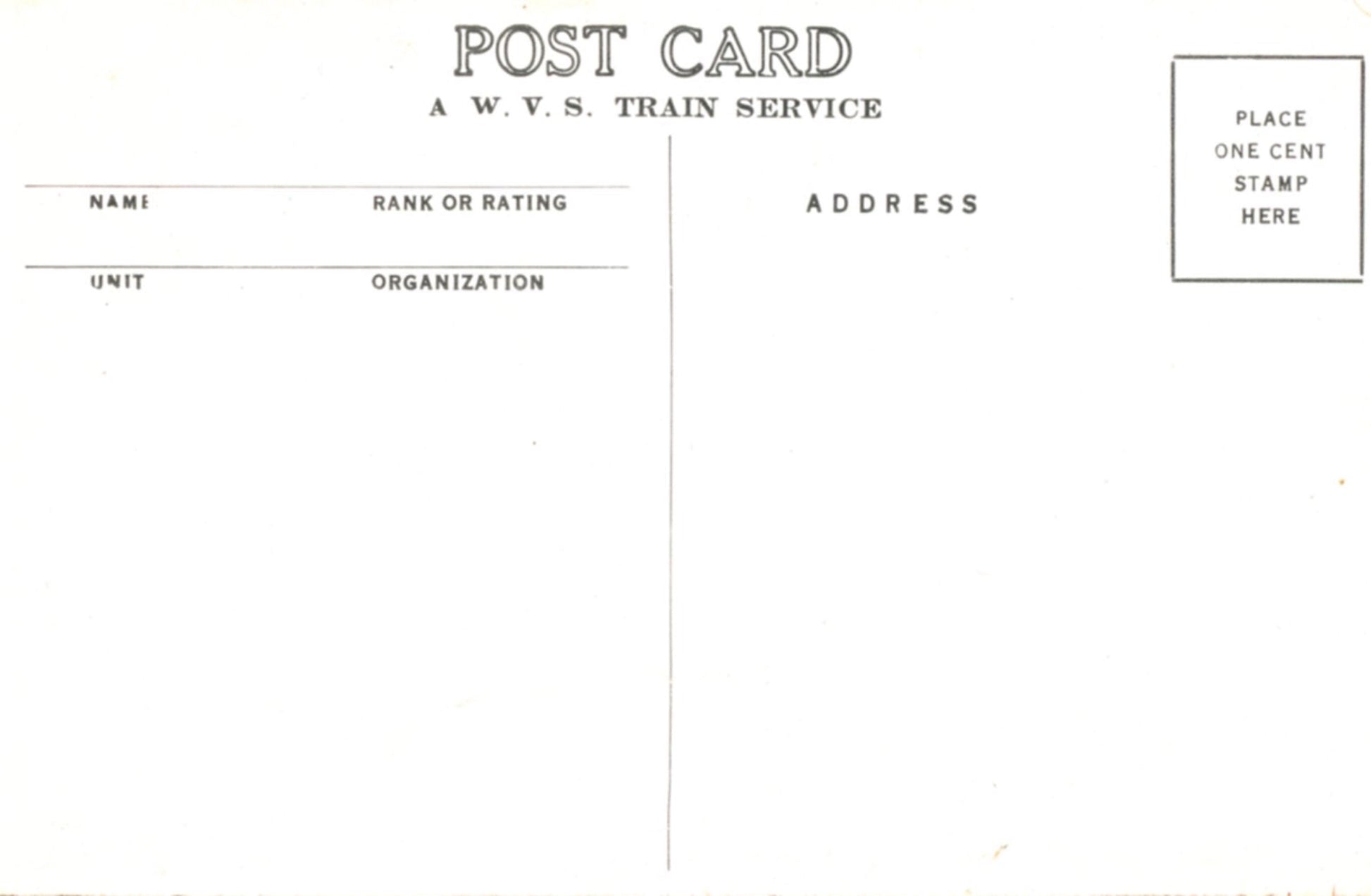
Space for sender to include Name, Rank/Rating, Unit and Organization on reverse.

Wartime linen‑style promotional postcard with military service back.

Collector’s Note

War Veterans Service (W.V.S.) Train Service postcards were issued during World War II for use by soldiers traveling on troop trains. Examples combining colorful linen-era promotional artwork with military service backs are less commonly encountered today and appeal to both postcard collectors and WWII ephemera enthusiasts.

This striking linen-era postcard promotes Butte, Montana — “The Richest Hill on Earth” — with bold poster-style artwork featuring a miner, a prospector, and iconic frontier imagery. The vivid red background, simplified figures, and booster-era slogans reflect the energetic graphic style of 1940s American tourism advertising, celebrating Butte as the “Last of the Western Frontier Towns,” “Metropolis of the Treasure State,” and the “World’s Greatest Mining Camp.”

What makes this example especially notable is its W.V.S. Train Service reverse, produced for correspondence by service members traveling aboard troop trains during World War II. Printed fields for Name, Rank or Rating, Unit, and Organization, together with the one-cent stamp box, firmly date the card to the wartime period of approximately 1942–1945. These hybrid postcards combined commercial travel imagery with military utility, creating a distinctive crossover collectible tied to both American tourism history and wartime transportation.

A vivid and historically rich example of wartime linen-era printing that captures both Montana’s mining identity and the everyday experiences of U.S. service members during the 1940s. Very good condition, with slight foxing and light staining visible primarily on the reverse. Packaged in a protective postcard sleeve.

Just a quick heads‑up: the photos reveal details far better than text alone, so they’re worth a close review.

We share as much accurate information as possible about each item—from provenance to condition—but the images often show the nuances best. If you ever need more details, we’re always happy to help.

View full details
  • Real Photo Postcards (c. 1890–1945)

    Early printed lithographs and Real Photo Postcards (RPPC) offer rich historical detail, documenting towns, events, family portraits, and everyday life. Disaster postcards depicting floods, fires, train wrecks, and other catastrophic events, were a popular way to share news as photographs could quickly be turned into postcards. Many RPPCs are scarce and unique due to their small‑batch production.

    Browse Real Postcards 
  • Pre-Linen Litho & Linen Postcards (c. 1907–1950)

    Pre‑Linen Litho cards (c. 1907–1929) were printed using smooth chromolithography and tinted halftone methods, producing soft, painterly views before the textured linen era. Linen postcards (c. 1930s–1950s) introduced high–rag‑content paper with a woven surface and bold saturated colors that reflected the optimism postwar travel culture. Together, these eras showcase the shift from early color printing.

    Browse Pre-Linen Litho and Linen Postcards 
  • Chrome Postcards (c.1939–)

    Chrome postcards, introduced in 1939, feature glossy surfaces, vivid color, and photographic imagery made possible by modern color film processes. The term “chrome” derives from Kodachrome, Eastman Kodak’s groundbreaking color film. Mid‑century examples depicting motels, highways, city skylines, national parks, and tourist destinations are collected for their documentation of postwar American travel and roadside culture.

    Browse Chrome Postcards