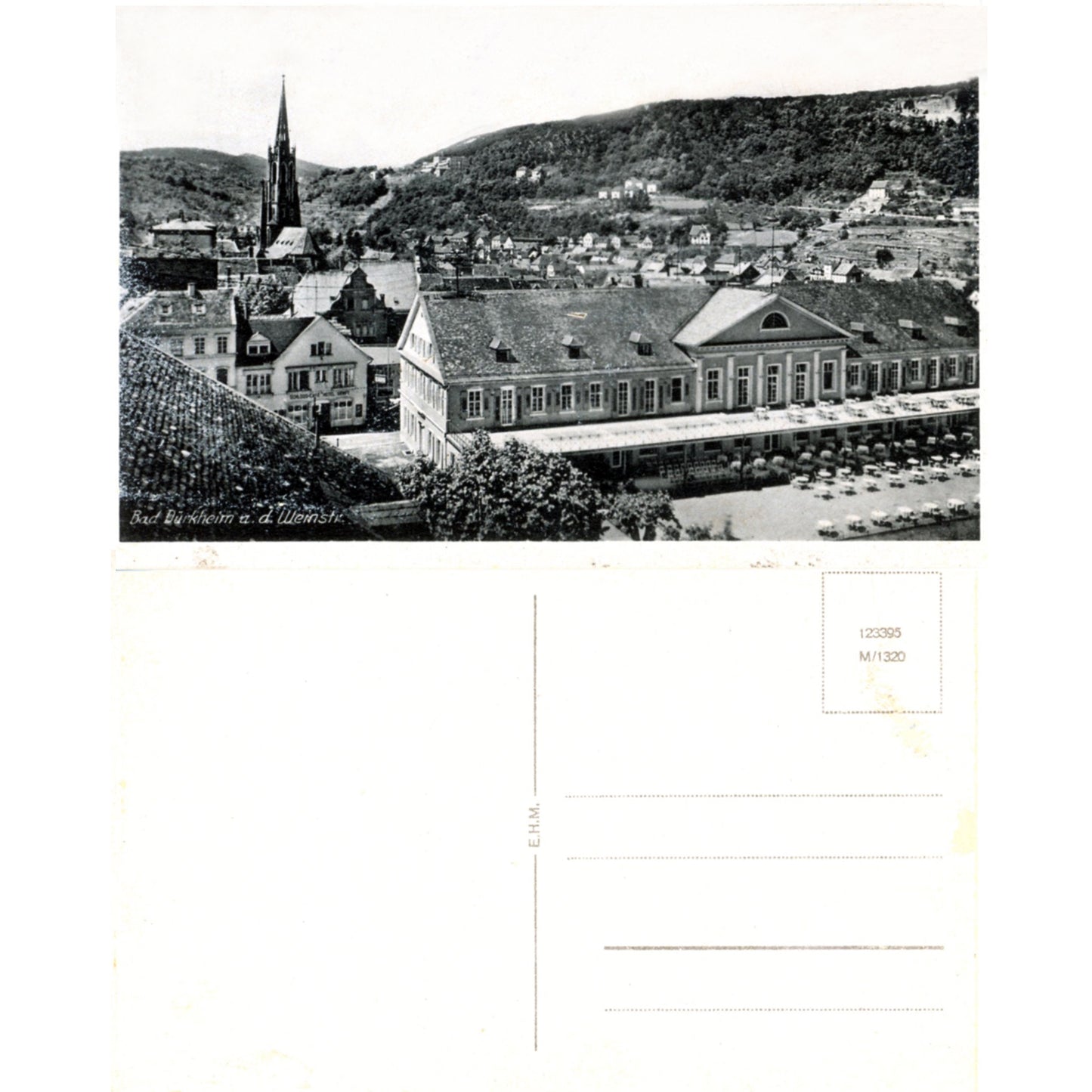
A curated selection of nine vintage Bad Dürkheim, Germany photographic postcards from the E.H.M. M/1320 series, capturing the architecture, spa culture, vineyards, and historic landmarks of the Palatinate wine region during the early 20th century. A cohesive group from the Bad Dürkheim wine region, issued as part of the M/1320 series. The divided backs are marked with the initials E.H.M., attributed to Emil Hartmann of Mannheim, a known German postcard publisher of the period.
Each postcard features a titled photographic view printed in white script and reflects the region’s identity as a center for wine production, health resorts, and historic architecture.
Collector’s Note
German regional postcard series like this were produced as cohesive visual tours—allowing travelers and collectors to experience a destination through architecture, landscape, and daily life.
The E.H.M. M/1320 series offers a particularly rich cross-section of Bad Dürkheim, from medieval ruins and vineyard vistas to early 20th-century sanatoriums and spa culture. When kept together, these cards form a compelling visual narrative of the region during a period of cultural, architectural, and political transition.
All cards remain unposted and are preserved in very good condition, housed individually in protective sleeves. Each postcard is housed in a protective sleeve and sold individually within this curated variant listing. The image displayed updates to reflect your selected view.
Limberg Abbey
Kloster Ruine Limberg bei Bad Dürkheim
Depicts the atmospheric ruins of Limburg Abbey at the edge of the Palatinate Forest. Originally established as a fortress in the 9th century and later converted into a monastery, the site was abandoned in the 16th century.
Condition: very good; minor edge chipping at top margin.
(123085 M/1320)
Limberg Abbey - Before & After
Einst Jetzt (Then & Now)
Split-image card contrasting an earlier architectural rendering with a later photographic view of the ruins, illustrating the site’s transformation over time.
Condition: very good.
(123103 M/1320)
Children's Hospital
Pfälzische Kinderheilstätte
Shows the regional children’s sanatorium, established in 1894 for long-term treatment of tuberculosis patients. A Nazi-era flag is visible in the background, placing the image within the 1933–1945 period.
Condition: very good; minor top edge chipping.
(123106 M/1320)
Hardenburg Castle
Ruine Hardenburg bei Bad Dürkheim
Features the expansive ruins of Hardenburg Castle, once a fortified residence of the Counts of Leiningen. The surviving structures reflect its Renaissance expansion and former scale.
Condition: very good; light edge wear.
(123385 M/1320)
Spa Hotel (Kurhaus)
Bad Dürkheim Kurhaus
Depicts the Kurhaus spa complex, which has served as a spa hotel since 1936. Originally constructed in 1822 on the site of a former baroque castle.
Condition: very good; slight edge chipping.
(123589 M/1320)
Medical Sanatorium
Sanatorium Sonnenwende
Illustrates a hillside sanatorium associated with early 20th-century therapeutic treatments, particularly for tuberculosis. Facilities like this were central to the region’s identity as a health destination.
Condition: very good; light edge rubbing.
(123395 M/1320)
Youth Hostel
Josef Bürckel Jugendherberge
Portrays a youth hostel along the German Wine Route. The naming reflects the political era in which the property operated.
Condition: very good.
(123397 M/1320)
The Largest Barrel
Das größte Faß der Welt
Depicts the famous “Giant Barrel,” constructed in 1934 and capable of holding approximately 1.7 million liters. Built from fir trees of the Black Forest, it functioned as a restaurant rather than a storage vessel.
Condition: very good; minor edge wear.
(123568 M/1320)
Aerial View
Bad Dürkheim a.d. Weinstraße
Sweeping elevated view of the town, including the Kurpark-Hotel, St. Ludwig Church, and surrounding vineyard landscape.
Condition: very good.
(123590 M/1320)
Dating Note (Historical Context)
Several cards in this series provide helpful visual markers for dating:
- The Pfälzische Kinderheilstätte (Children’s Hospital) image includes a Nazi-era flag (with central emblem) visible on the grounds, placing that photograph within the 1933–1945 period.
- The Kurhaus (Spa Hotel) is shown in its later function as a spa property, a use established in 1936, providing an additional reference point.
Together, these details support an overall dating of the series to circa 1920–1940, consistent with the M/1320 production style.