


Real Photo Postcard (RPPC)
1909 RPPC Uniformed Young Man Indianapolis to New York Military Style Portrait Postcard
1909 RPPC Uniformed Young Man Indianapolis to New York Military Style Portrait Postcard
Flat $2.00 USPS First Class shipping on all postcards within the continental USA.
Flat $2.00 USPS First Class shipping on all postcards within the continental USA.
Low stock: 1 left
Couldn't load pickup availability
AT A GLANCE
- Title:
- "Studio Portrait of Uniformed Young Man"
- Type:
- Standard Size Postcard (3 ½” x 5 ½”)
- Subject:
- Uniformed young man (military-style)
- Style:
- Portrait / documentary photography
- Era:
- Edwardian Era (1901–1914)
- Date:
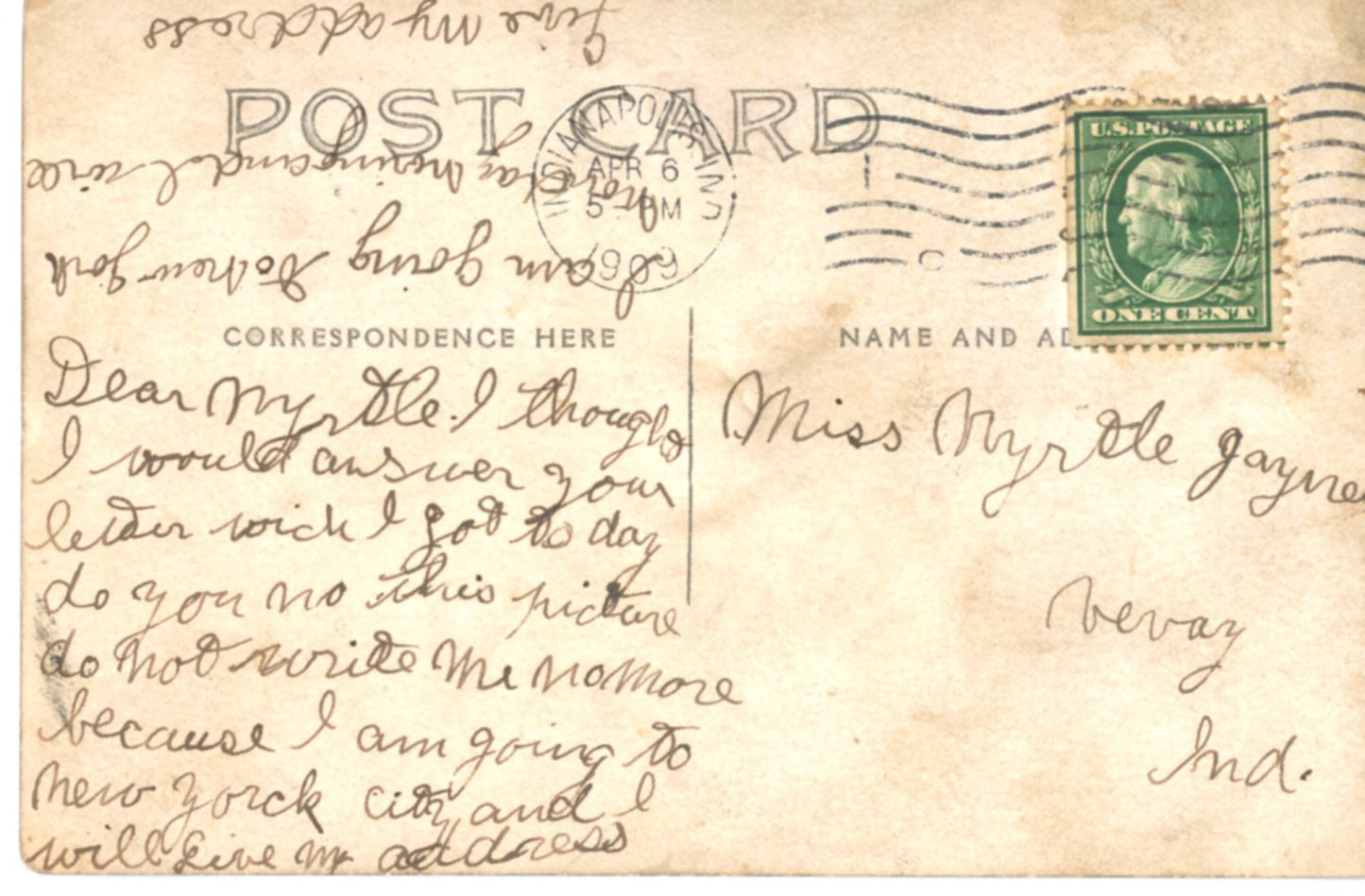
- Postmark: April 6, 1909
- Print type:
- Silver gelatin real photo (AZO paper)
- Condition:
- Very good-excellent (VG-EX)
- Color:
- Sepia toned
- Postcard:
- Real Photo (RPPC)
- Location:
- Indianapolis, Indiana (posted); Vevay, Indiana (recipient)
- Postmark:
- Postally Used | Stamped | Message
Striking 1909 real photo postcard portrait of a young man in a military-style uniform, captured at a moment of transition and movement.
Collector’s Note
📌 Early real photo postcards featuring uniformed young men are widely collected for their connection to military service, preparatory academies, and personal histories—often capturing moments just before major life transitions.
This black and white studio portrait postcard, postmarked April 6, 1909, from Indianapolis, Indiana, features a young man dressed in a structured military-style uniform with high-collared tunic, brass buttons, and cap. While the exact affiliation is not identified, the uniform is consistent with early 20th-century cadet corps, preparatory academies, or militia-style dress.
The handwritten message adds a compelling personal narrative, written to Miss Myrtle Jaymes of Vevay, Indiana. In it, the sender explains he is preparing to travel to New York City and asks her to wait for his new address before writing again..
Given the 1909 Indianapolis cancellation and the sender’s note about traveling to New York—a region home to several well-known military and preparatory academies—the portrait may suggest a connection to formal military or preparatory training, an association that adds to the postcard’s historical interest, though no specific institution is identified.

Printed on AZO photographic paper (four triangles up), this postcard dates squarely within the Golden Age of postcards and retains strong visual contrast and tonal depth typical of silver gelatin processes.
A particularly appealing piece for collectors of military-themed photography, early 20th-century portraiture, or historically grounded personal correspondence.
Very good condition with light edge wear, including wear at the top left corner and a small crease near the lower edge by the subject’s shoe. Postally used with clear cancellation and legible handwritten message. Displays well and will ship in a protective postcard sleeve.
Just a quick heads‑up: the photos reveal details far better than text alone, so they’re worth a close review.
Just a quick heads‑up: the photos reveal details far better than text alone, so they’re worth a close review.
We share as much accurate information as possible about each item—from provenance to condition—but the images often show the nuances best. If you ever need more details, we’re always happy to help.

Postcard Eras & Collecting Guide
-

Real Photo Postcards (c. 1890–1945)
Browse Real PostcardsEarly printed lithographs and Real Photo Postcards (RPPC) offer rich historical detail, documenting towns, events, family portraits, and everyday life. Disaster postcards depicting floods, fires, train wrecks, and other catastrophic events, were a popular way to share news as photographs could quickly be turned into postcards. Many RPPCs are scarce and unique due to their small‑batch production.
-

Pre-Linen Litho & Linen Postcards (c. 1907–1950)
Browse Pre-Linen Litho and Linen PostcardsPre‑Linen Litho cards (c. 1907–1929) were printed using smooth chromolithography and tinted halftone methods, producing soft, painterly views before the textured linen era. Linen postcards (c. 1930s–1950s) introduced high–rag‑content paper with a woven surface and bold saturated colors that reflected the optimism postwar travel culture. Together, these eras showcase the shift from early color printing.
-

Chrome Postcards (c.1939–)
Browse Chrome PostcardsChrome postcards, introduced in 1939, feature glossy surfaces, vivid color, and photographic imagery made possible by modern color film processes. The term “chrome” derives from Kodachrome, Eastman Kodak’s groundbreaking color film. Mid‑century examples depicting motels, highways, city skylines, national parks, and tourist destinations are collected for their documentation of postwar American travel and roadside culture.


