Skip to product information
1 of 6

Women's Auxiliary of Olivet Episcopal Church

Virginia Cookery: Past and Present – Women’s Auxiliary of Olivet Episcopal Church (1957, 11th Edition)

Virginia Cookery: Past and Present – Women’s Auxiliary of Olivet Episcopal Church (1957, 11th Edition)

Regular price $22.00 USD
Regular price Sale price $22.00 USD
Sale Sold out
Shipping calculated at checkout.

Low stock: 1 left

Quantity

AT A GLANCE

Title:
"Virginia Cookery: Past and Present"
Type:
Cookbook
Style:
Community & Fundraising Cookbook; Southern Colonial Cooking
Artist:
Marguerite Burgess, Cover Artist
Author:
Women's Auxiliary of Olivet Episcopal Church
Era:
Late 20th Century (1970–1999)
Date:
1993 (1957 11th edition)
Origin:
Franconia, Virginia
Condition:
Very good-excellent (VG-EX)
Location:
Alexandra, Virginia USA
Cover:
Softcover comb-bound
Pages:
449
ISBN:
9781103635450
Book genre:
Community & Junior League
Notes:
Southern Living Hall of Fame
🏆 Southern Living Hall of Fame Winner

A historic Virginia community cookbook spanning 300+ years of culinary tradition.

Virginia Cookery: Past and Present, compiled by the Women’s Auxiliary of Olivet Episcopal Church in Franconia, Virginia, is one of the most historically significant community cookbooks ever produced. First published in 1957, this 11th edition (1993) continues the book’s legacy as both a culinary collection and a cultural document, tracing Virginia’s foodways back to the earliest English settlers in 1619.

This title was honored with the Southern Living Hall of Fame Award, a distinction reserved for community cookbooks of exceptional popularity, longevity, and cultural impact. A gold Southern Living Hall of Fame seal is on the cover, underscoring the book’s enduring reputation.

Southern Living Hall of Fame 

The Southern Living Hall of Fame recognizes cookbooks that reflect the richness of Southern culinary tradition and culture. Selected by Southern booksellers and industry experts, these titles stand out for their quality, regional character, and lasting appeal.

For collectors, this designation signals a cookbook of distinction—especially when examples retain their original award sticker, preserving how the book was first presented and marketed.

The mid‑century cover, illustrated by Marguerite Burgess, is a charming collage of stylized kitchen motifs rendered in green linework against a warm yellow background. Corn, a chicken, a rolling pin, a potted herb, a cooking pot, and a cooking bottle appear in playful, modernist forms. 

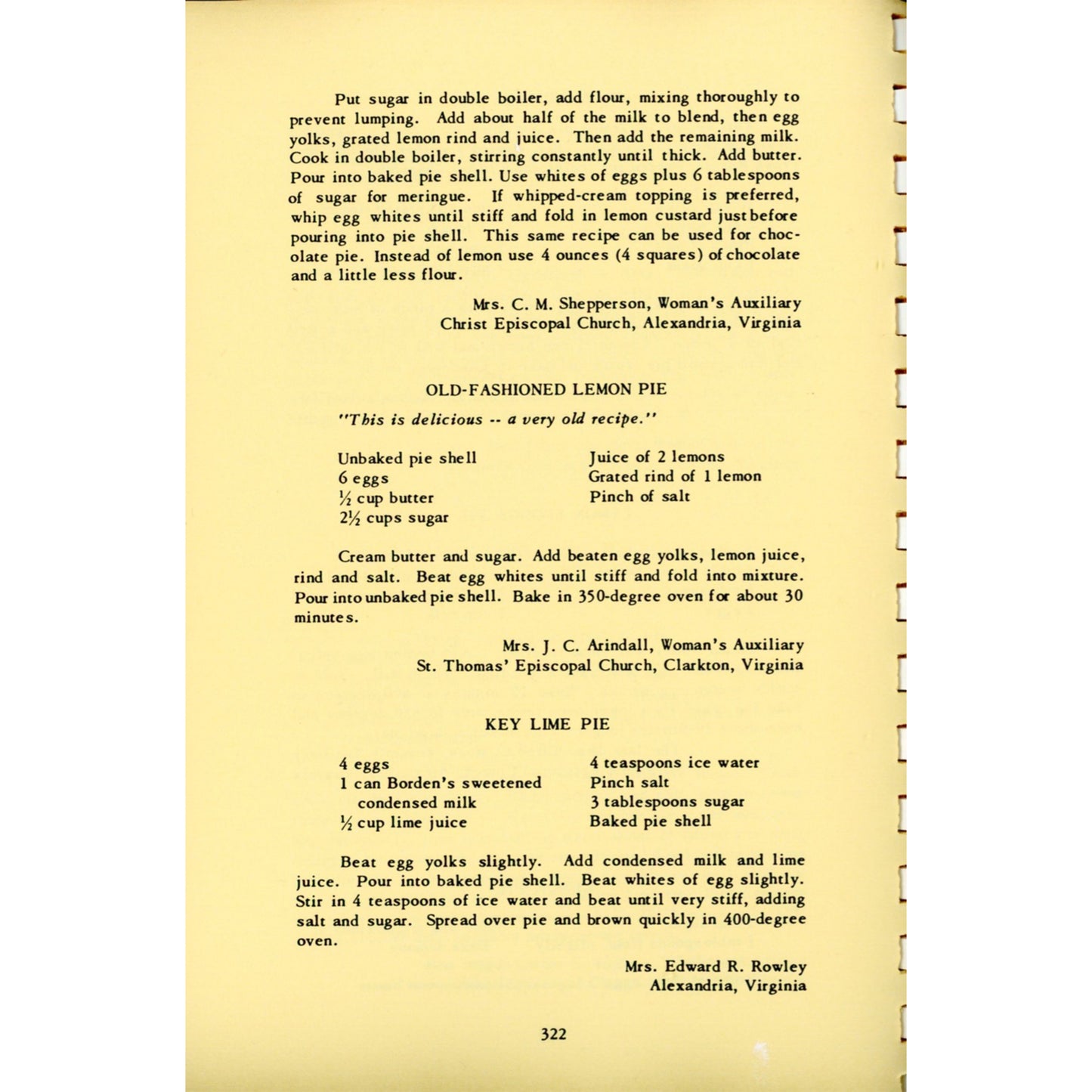
Inside, the cookbook reads like a culinary time capsule. Recipes from some of America’s earliest families — including the Lees and Washingtons — appear throughout. Many were transcribed directly from Mrs. Richard Bland Lee’s handwritten manuscript, passed down through five generations and published here for the first time. These early recipes sit alongside contributions from women across Virginia’s auxiliaries, churches, and clubs, each credited with name, location, and organization.

The collection includes both everyday dishes and historically rooted specialties such as Deviled Crab, Westmoreland Club Mint Julep, Beene Cookies, Fried Chicken, Queen Elizabeth Cake, Penn‑Daw Cornsticks, Eastern Shore Clam Fritters, Martha Washington Cake, and Sally Lunn Bread. Many entries include brief historical notes or cooking commentary, adding depth and context to the recipes.

This copy is in very good to excellent condition. A beautifully preserved example of a beloved Virginia classic.

Browse our complete Community & Junior League Cookbooks collection for more fundraising cookbooks and recipes.

Just a quick heads‑up: the photos reveal details far better than text alone, so they’re worth a close review.

We share as much accurate information as possible about each item—from provenance to condition—but the images often show the nuances best. If you ever need more details, we’re always happy to help.

View full details

The Legacy of Community Cookbooks

Community cookbooks are valued for their historical significance, their role in fundraising, and their ability to preserve culinary traditions. Often passed down through families with handwritten notes on time-worn pages, they reveal an intimate look into American culture and social norms—particularly the role of women.

Naming conventions like "Mrs. John A. Smith" reflect the hierarchy and identity of women during an era of limited societal power; while the recipes reflect food trends, kitchen technologies, and patterns of cultural assimilation. These cookbooks trace the larger story of America as it was reshaped by immigration, urban growth, and industrial change.

The tradition began during the Civil War with Maria J. Moss's, A Poetical Cookbook (1864), which raised funds for soldiers' families. Junior League organizations are major publishers, first publishing The Junior League Recipe Book (1930). Many have maintained popularity through the generations—like Charleston Receipts (1950), the oldest community cookbook that is still in print today.