Skip to product information
1 of 2

St. Mark's Lutheran Church

Culinary Art from St. Mark's Kitchen | St. Mark Lutheran Church | Batesville, IN | Circa 1950s - 1960s

Culinary Art from St. Mark's Kitchen | St. Mark Lutheran Church | Batesville, IN | Circa 1950s - 1960s

Regular price $12.00 USD
Regular price Sale price $12.00 USD
Sale Sold out
Shipping calculated at checkout.

Low stock: 1 left

Quantity

AT A GLANCE

Title:
"Culinary Art from St. Mark's Kitchen"
Publisher:
Saint Mark Lutheran Church
Type:
Cookbook
Style:
Community & Fundraising Cookbook; Church potluck
Era:
Mid-20th Century (1946 - 1969)
Circa:
1950s
Origin:
Batesville, Indiana
Dimensions:
5 ½” x 8 ½”
Condition:
Good (G)
Ephemera:
Culinary pamphlet
Location:
Batesville, Indiana USA
Cover:
Staple‑bound softcover
Book genre:
Community & Junior League

Culinary Art from St. Mark’s Kitchens is a cherished community cookbook created by members of St. Mark Lutheran Church in Batesville, Indiana—a congregation founded in 1897 and long admired for its arched sanctuary, stained‑glass windows, and deep roots in the region’s German‑American heritage.

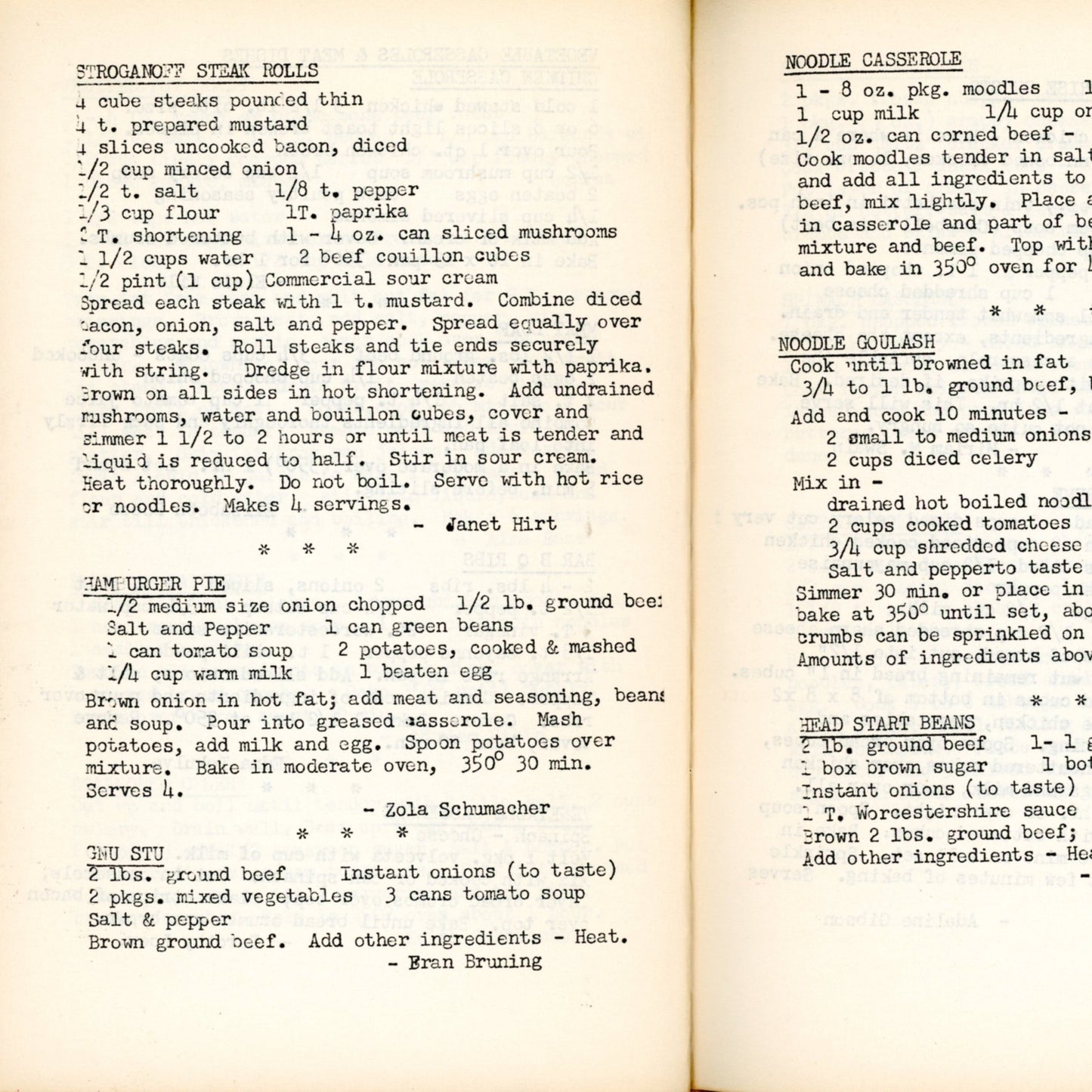
This volume gathers the everyday cooking traditions of mid‑century church families, preserving beloved dishes contributed by home cooks such as Juanita Lindemann (Parmesan Canapés), Alma Bass (Peach Conserve), and Adeline Gibson (Chicken Dressing Supreme). Recipes are typed in the familiar, practical style of the era, reflecting the foods served at potlucks, family tables, and church suppers.

Based on ingredient clues (including the use of Spry Vegetable Shortening), contributor research, and the simple typewritten layout, the cookbook was most likely compiled in the late 1950s to early 1960s. Pages appear to have been produced on a mimeograph machine, the standard duplicating method for church and civic cookbooks of the period.

The booklet measures 5½ × 8½ inches and offers a nostalgic, primary‑source snapshot of mid‑century community cooking in southeastern Indiana.

Browse our complete Community & Junior League Cookbooks collection for more fundraising cookbooks and recipes.

Just a quick heads‑up: the photos reveal details far better than text alone, so they’re worth a close review.

We share as much accurate information as possible about each item—from provenance to condition—but the images often show the nuances best. If you ever need more details, we’re always happy to help.

View full details

The Legacy of Community Cookbooks

Community cookbooks are valued for their historical significance, their role in fundraising, and their ability to preserve culinary traditions. Often passed down through families with handwritten notes on time-worn pages, they reveal an intimate look into American culture and social norms—particularly the role of women.

Naming conventions like "Mrs. John A. Smith" reflect the hierarchy and identity of women during an era of limited societal power; while the recipes reflect food trends, kitchen technologies, and patterns of cultural assimilation. These cookbooks trace the larger story of America as it was reshaped by immigration, urban growth, and industrial change.

The tradition began during the Civil War with Maria J. Moss's, A Poetical Cookbook (1864), which raised funds for soldiers' families. Junior League organizations are major publishers, first publishing The Junior League Recipe Book (1930). Many have maintained popularity through the generations—like Charleston Receipts (1950), the oldest community cookbook that is still in print today.