Skip to product information
1 of 4

FoxChase Women's Club

Foxchase Favorites — Foxchase Women’s Club of Aiken, South Carolina (c.1980)

Foxchase Favorites — Foxchase Women’s Club of Aiken, South Carolina (c.1980)

Regular price $16.00 USD
Regular price Sale price $16.00 USD
Sale Sold out
Shipping calculated at checkout.

Low stock: 1 left

Quantity

AT A GLANCE

Title:
FoxChase Favorites
Publisher:
Keepsake Cookbooks
Artist:
Wilma Becker
Author:
FoxChase Womens Club
Era:
Late 20th Century (1970–1999)
Circa:
1980
Origin:
Aiken, Georgia USA
Dimensions:
6" x 8 ½"
Condition:
Very Good (VG)
Cover:
Softcover comb-bound
Pages:
376
OCLC:
1517943657
Book genre:
Community & Junior League

A rare, 376‑page community cookbook from a small Aiken neighborhood women’s club.

Foxchase Favorites is a charming and exceptionally scarce community cookbook compiled by the Foxchase Women’s Club of Aiken, South Carolina. With more than 376 pages, it reflects the breadth of home cooking traditions shared among the women of the Foxchase neighborhood — a small, close‑knit community whose history survives today largely through cookbooks like this one.

The book features original illustrations by Wilma Becker, a local artist whose hand‑drawn work adds warmth and personality to the collection. Like many neighborhood cookbooks of the late 1970s and early 1980s, Foxchase Favorites was likely produced in a small print run for residents, friends, and family. Its publisher, Keepsake Cookbooks of Savannah, Tennessee, operated during this period, giving WorldCat reason to estimate a circa‑1980 publication date.

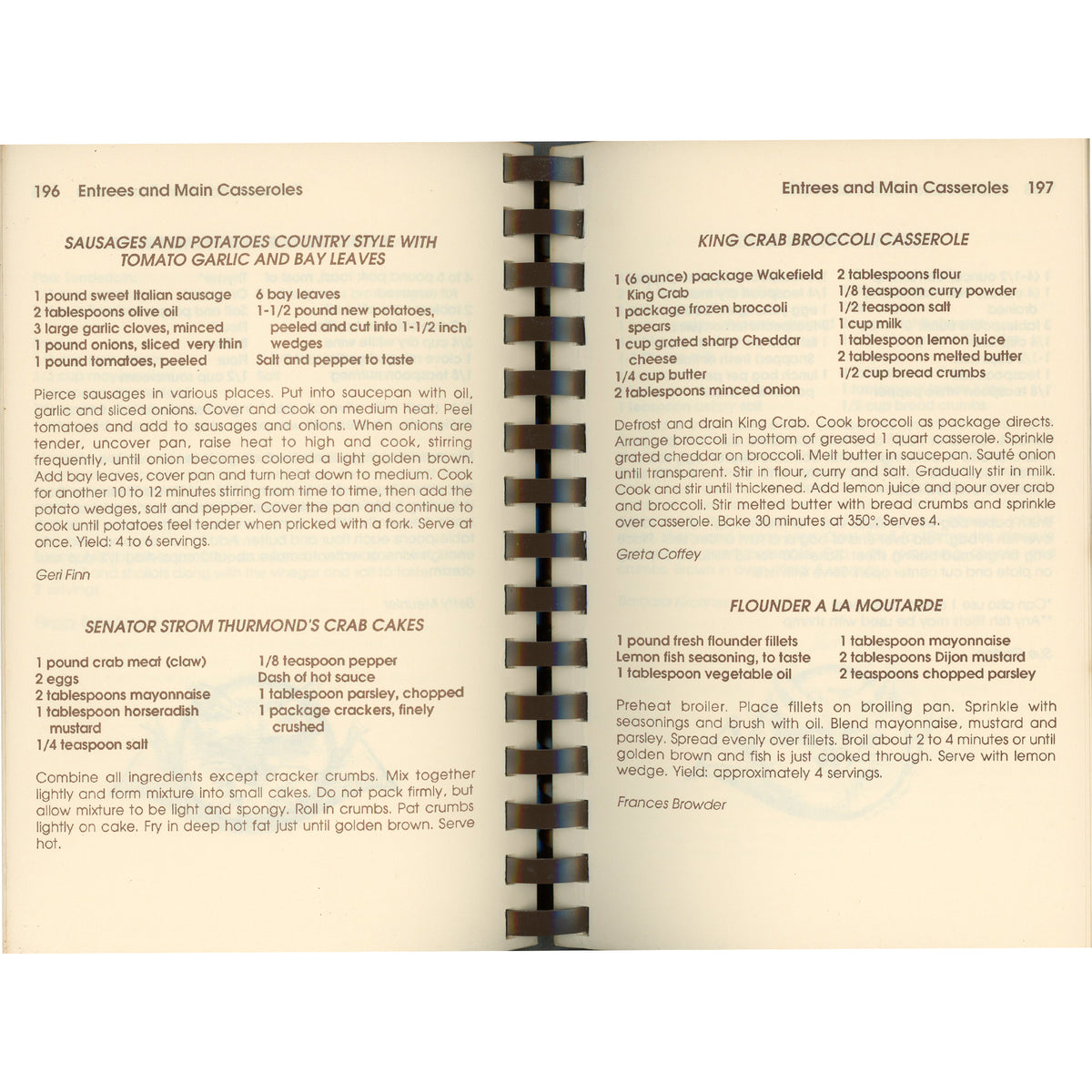
Inside, you’ll find a wide range of recipes typical of Southern and mid‑Atlantic home cooking — casseroles, holiday dishes, desserts, breads, salads, and family favorites — contributed by the women of the Foxchase community. These recipes include Trawler Seafood Restaurant's Signature Famous Crab Dip and Senator Strom Thurmond's Crab Cakes. 

Provenance Note

An original order form remains bound into the back of the book, directing purchasers to Mrs. John (Betty) Meunier, at 1541 Citation Drive, Aiken, SC 29801. This address places the Meunier household within the Foxchase neighborhood, strongly suggesting that Betty Meunier served as the club’s coordinator for cookbook orders and distribution.

Property records show that Meuniers sold the home in1989, confirming the family’s presence in the neighborhood during the period in which the cookbook was likely compiled. Because the Foxchase Women’s Club left no surviving public record, this order form is one of the few tangible pieces of documentation linking the cookbook to its creators — making this copy especially valuable for collectors of Aiken history, South Carolina community cookbooks, and neighborhood‑club ephemera.

This comb-bound copy is in good condition and shows little if any use. There is browning on the back cover and edges of some interior pages. No markings. A collector‑worthy example.

Browse our complete Community & Junior League Cookbooks collection for more fundraising cookbooks and recipes.

Just a quick heads‑up: the photos reveal details far better than text alone, so they’re worth a close review.

We share as much accurate information as possible about each item—from provenance to condition—but the images often show the nuances best. If you ever need more details, we’re always happy to help.

View full details

The Legacy of Community Cookbooks

Community cookbooks are valued for their historical significance, their role in fundraising, and their ability to preserve culinary traditions. Often passed down through families with handwritten notes on time-worn pages, they reveal an intimate look into American culture and social norms—particularly the role of women.

Naming conventions like "Mrs. John A. Smith" reflect the hierarchy and identity of women during an era of limited societal power; while the recipes reflect food trends, kitchen technologies, and patterns of cultural assimilation. These cookbooks trace the larger story of America as it was reshaped by immigration, urban growth, and industrial change.

The tradition began during the Civil War with Maria J. Moss's, A Poetical Cookbook (1864), which raised funds for soldiers' families. Junior League organizations are major publishers, first publishing The Junior League Recipe Book (1930). Many have maintained popularity through the generations—like Charleston Receipts (1950), the oldest community cookbook that is still in print today.