Arthur Ignatius Keller
Early 1900s Golden Age Illustration – Arthur I. Keller Eskimo Village Collotype Print on Embossed Mount
Couldn't load pickup availability
AT A GLANCE
- Title:
- Eskimo Village
- Type:
- Golden Age Illustration
- Subject:
- Ethnographic Inuit (Eskimo) Village
- Artist:
- Arthur Ignatius Keller (1867–1924)
- Signature:
- Right bottom corner
- Circa:
- Early 1900s
- Print type:
- Halftone Lithographic | Collotype
- Material:
- Paper
- Dimensions:
- 8" x 11" print (12 ½” x 17" mount)
- Mounting:
- String hanger
- Book genre:
- Art | Illustrated
Low stock: 1 left
A Glimpse of Arctic Life During the Golden Age of Illustration
Collectors of Golden Age illustration value this Arthur Ignatius Keller print for its atmospheric depiction of Inuit village life and its early collotype printing process, which preserves the artist’s subtle wash tones without the dot pattern of halftone reproduction. Surviving examples mounted on their original embossed presentation boards with hanging strings are increasingly scarce.
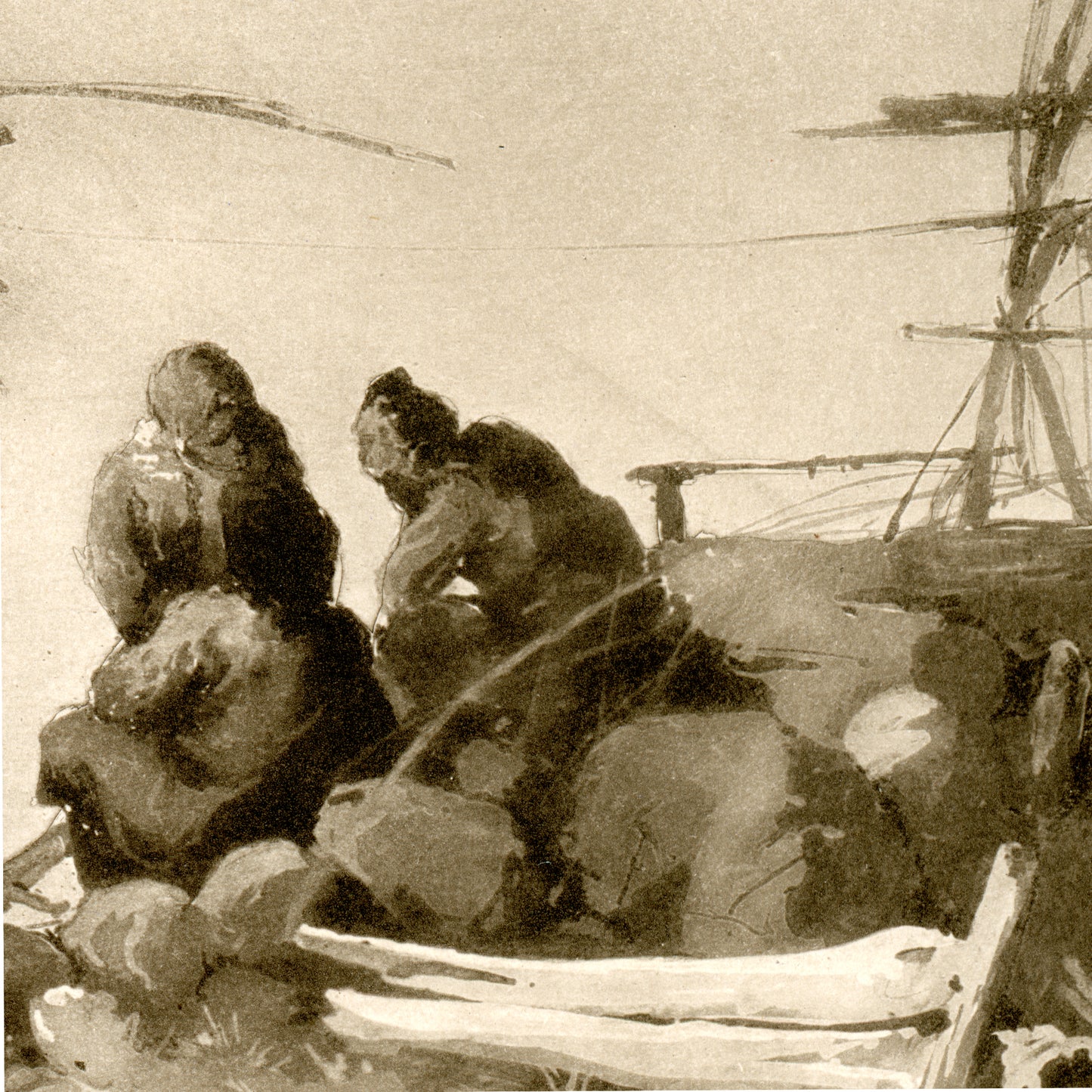
This early 1900s illustration print titled Eskimo Village showcases the refined tonal work of American illustrator Arthur Ignatius Keller, one of the artists associated with the Golden Age of American Illustration. Printed using the collotype process, an early photographic printing technique prized for its ability to reproduce continuous tonal detail, the image faithfully captures the soft wash shading and atmospheric quality of Keller’s original drawing. (See high resolution image)
The scene depicts a quiet Inuit settlement with figures gathered near tents and drying racks while a child stands in a small skin-covered boat in the foreground. Keller’s layered composition—foreground figures, a central family group, and detailed background structures—reflects the storytelling style commonly used in magazine and book illustrations of the period.
Early 20th-century mounted illustration prints like this were often produced as decorative or educational premium prints intended for wall display, making intact examples with their original presentation mounts increasingly uncommon.
The print remains affixed to its original heavy cardstock presentation mount, which features a blind-embossed window framing the image. The mount’s symmetrical margins and original hanging string indicate factory production, designed to mimic the appearance of a matted and framed artwork ready for display.
The image itself remains in excellent condition, showing crisp detail and strong tonal range. The mount is in less fair condition, displaying expected age toning, scattered foxing, and edge wear consistent with its age. Many collectors choose to reframe prints like this for display while preserving the original mount for provenance.
At the turn of the 20th century, public fascination with Arctic exploration brought images of Inuit life to magazines and illustrated books. Keller’s scene reflects the ethnographic imagery popular during this era, when accounts from explorers such as Robert Peary and Fridtjof Nansen introduced readers to northern cultures and landscapes.
The print displays beautifully when newly framed, particularly in natural wood, black, or neutral Arctic-tone frames that complement Keller’s restrained palette. Once framed, the piece makes a striking addition to collections of Golden Age illustration, exploration history, or ethnographic imagery.
Arthur Ignatius Keller (1867–1924) was an American illustrator known for his atmospheric pen-and-ink and wash drawings. Trained in Munich and New York, Keller illustrated numerous books and magazines and collaborated with authors including Mark Twain and Winston Churchill (the American novelist). His illustrations often depicted dramatic landscapes and scenes of daily life, reflecting the storytelling tradition of the Golden Age of Illustration.
We ask that when making your purchasing decision that you consider the photos as part of the item's description.
We do our best to provide you within the written description as much information, whether it’s the history, manufacturer, or condition, for each item we sell.
We also recognize that a “picture is worth a thousand words” and ask that you view the photos we provide closely. Often, a photo can be more effective than a written description when determining if an item will meet your needs and satisfaction.
If you need additional information on this or any item, please do not hesitate to reach out.
Share this listing.
