Skip to product information
1 of 4

American Pottery

Antique Rockingham Turk’s Head Cake Mold – Tortoiseshell Glaze, 19th Century Stoneware

Antique Rockingham Turk’s Head Cake Mold – Tortoiseshell Glaze, 19th Century Stoneware

Regular price $95.00 USD
Regular price Sale price $95.00 USD
Sale Sold out
Shipping calculated at checkout.

Low stock: 1 left

Quantity

AT A GLANCE

Type:
Cake Mold | Baking Mold
Style:
Rockingham / Tortoiseshell glaze
Era:
Victorian (1830 - 1901)
Circa:
1850 - 1880
Origin:
United States
Material:
Stoneware
Dimensions:
8” diameter
Condition:
Very Good (VG) | Antique
Color:
Butterscotch, caramel, deep brown
Pattern:
Molded, glazed

19th Century Rockingham Turk’s Head Cake Mold with Rich Mottled Brown Glaze

Collector’s Note

Rockingham pottery became a staple of 19th-century American kitchens, prized for its durability and distinctive mottled brown glaze often compared to tortoiseshell. Produced roughly between 1840 and 1900, these wares were both practical and visually appealing, with forms ranging from simple utilitarian vessels to more sculptural designs. Today, collectors value pieces with strong glaze variation and well-defined forms.

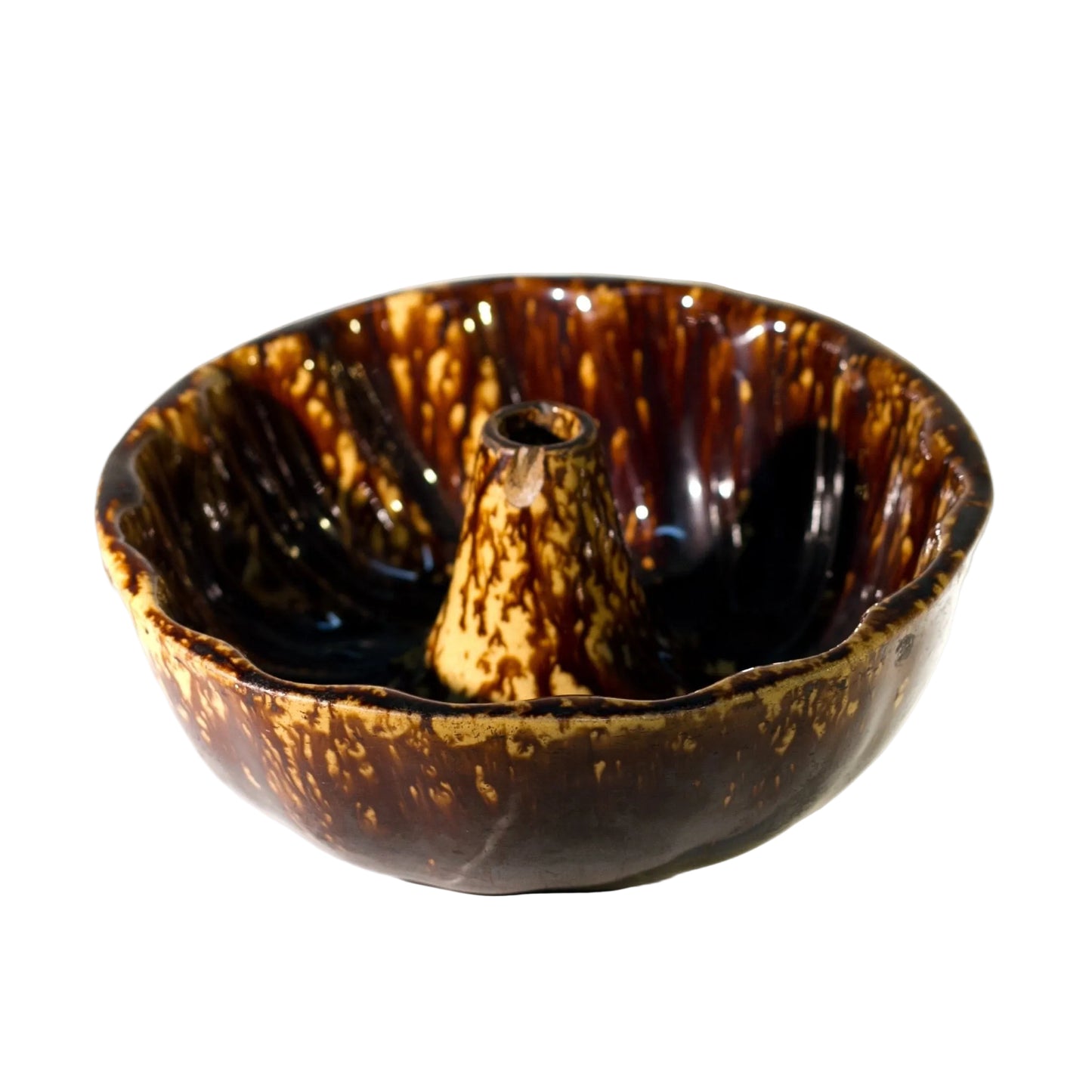
A classic and highly collectible form, this 19th-century Rockingham Turk’s Head cake mold (similar to a tube pan) features a beautifully molded, fluted interior designed to create decorative cakes. This example was likely produced in stoneware, as indicated by the medium brown clay body visible at areas of wear. 

The surface is finished in a rich, tortoiseshell glaze, where deep brown tones are heavily mottled over a warm butterscotch ground. The glaze flows dramatically across the fluted interior and central tube, emphasizing the sculptural quality of the form and creating striking contrast. 

Historical Note

Rockingham pottery refers to the warm brown‑glazed earthenware and stoneware produced during the 19th century. By the 1830s–40s, American potteries from New York and New Jersey to Pennsylvania, Ohio, Maryland, Vermont, and Illinois were producing Rockingham‑style vessels.

American Rockingham began as utilitarian household pottery—pitchers, teapots, cooking vessels, spittoons—but evolved into “fancy ware” by the mid‑19th century, with relief‑molded floral and figurative designs. The glaze itself could appear mottled, streaked, or spattered, giving each piece a distinctive surface character.

Rockingham is often mistakenly labeled “Bennington,” a term tied to the brown‑glazed wares produced in Bennington, Vermont. For collectors, attribution matters because confirmed Bennington pieces typically command higher prices. 

Originally used for baking, molds like this are now prized for their dual appeal as functional antiques and decorative objects, equally at home in a kitchen display or on open shelving. Measures 8” diameter by 2 ¾” high.  The piece is in very good antique condition. There is a chip at the top of the central tube measuring approximately ¼” wide × ½” long. The base shows typical kiln-related flat spots and variations in glaze brightness from firing. 

With its fluted form and rich glaze, this mold makes a striking display piece when hung on a wall or placed on open shelving. It pairs beautifully with other early American ceramics.

Explore our Antique & Vintage Pottery collections for more Rockingham, redware, yellowware, salt-glazed stoneware, art pottery, and earthenware pieces shaped from clays using regional pottery traditions.

Just a quick heads‑up: the photos reveal details far better than text alone, so they’re worth a close review.

We share as much accurate information as possible about each item—from provenance to condition—but the images often show the nuances best. If you ever need more details, we’re always happy to help.

View full details