Substantial 19th Century Rockingham Pitcher with Ribbed Body & Rich Mottled Glaze
Collector’s Note
Rockingham pottery became a staple of 19th-century American kitchens, prized for its durability and distinctive mottled brown glaze often compared to tortoiseshell. Produced roughly between 1840 and 1900, these wares were both practical and visually appealing, with forms ranging from simple utilitarian vessels to more sculptural designs. Today, collectors value pieces with strong glaze variation and well-defined forms.
A wonderful and substantial example of 19th-century Rockingham pottery, this pitcher features a classic ribbed, columnar body set on a pedestal-style base, giving it both visual strength and architectural presence.
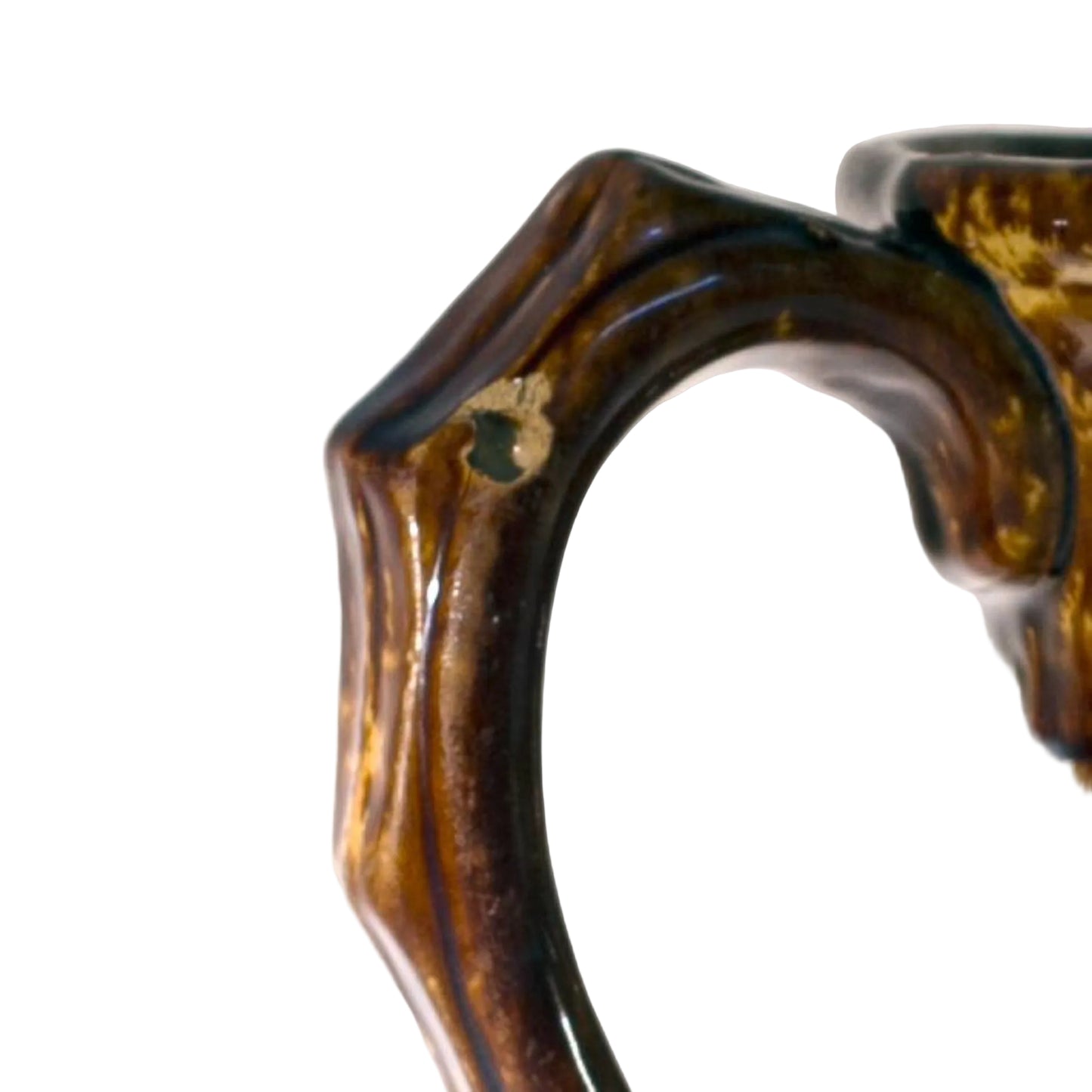
The surface is finished in a richly variegated tortoiseshell glaze, where deep reddish-brown tones are mottled over a warm butterscotch ground. The glaze pools and shifts naturally across the form, creating depth and movement, while the interior transitions from a darker brown near the rim to a lighter tone toward the base. The molded handle, with its slightly faceted form, complements the vertical ribbing of the body, while the pronounced spout adds to its functional and sculptural appeal.
Historical Note
Rockingham pottery refers to the warm brown‑glazed earthenware and stoneware produced during the 19th century. By the 1830s–40s, American potteries from New York and New Jersey to Pennsylvania, Ohio, Maryland, Vermont, and Illinois were producing Rockingham‑style vessels.
American Rockingham began as utilitarian household pottery—pitchers, teapots, cooking vessels, spittoons—but evolved into “fancy ware” by the mid‑19th century, with relief‑molded floral and figurative designs. The glaze itself could appear mottled, streaked, or spattered, giving each piece a distinctive surface character.
Rockingham is often mistakenly labeled “Bennington,” a term tied to the brown‑glazed wares produced in Bennington, Vermont. For collectors, attribution matters because confirmed Bennington pieces typically command higher prices.
This is a heavier example, weighing approximately four pounds, reinforcing its utilitarian origins while making it an impressive display piece today. It measures 8” high with a 6” base diameter; approximately 9” from handle to spout.
Good antique condition. There is a chip along the rim measuring approximately ½” wide × ¼” high, and a small circular loss (approximately ¼”) on the handle. These areas reveal a medium brown clay body, consistent with stoneware forms used in Rockingham production. The piece remains structurally sound and displays well.
Makes a striking standalone statement or pairs beautifully with other early American ceramics, adding warmth and depth through its earthy tones and sculptural presence.
Explore our Antique & Vintage Pottery collections for more Rockingham, redware, yellowware, salt-glazed stoneware, art pottery, and earthenware pieces shaped from clays using regional pottery traditions.